Nanospider™ Technology Enabling Award-Winning Biomedical Research
When Nanofibers Heal and Disappear
Biodegradable vascular bandage research awarded by the Czech Ministry of Health
Modern cardiovascular surgery depends on materials that must perform flawlessly under extreme biological and mechanical conditions. Strength, flexibility, safety and long‑term compatibility are non‑negotiable. But what if such a material could do its job and then quietly disappear?
A multidisciplinary Czech research team has shown that this vision is realistic. Their four‑year project focused on developing a biodegradable nanofibrous vascular bandage that mechanically supports damaged blood vessels, promotes tissue regeneration, and degrades gradually within the body. For this achievement, the entire research consortium received Honourable Mention of the Czech Minister of Health for Medical Research and Development 2025.
ELMARCO is proud that Nanospider™ electrospinning technology played a key role in this award‑winning research.
From permanent materials to temporary healing support
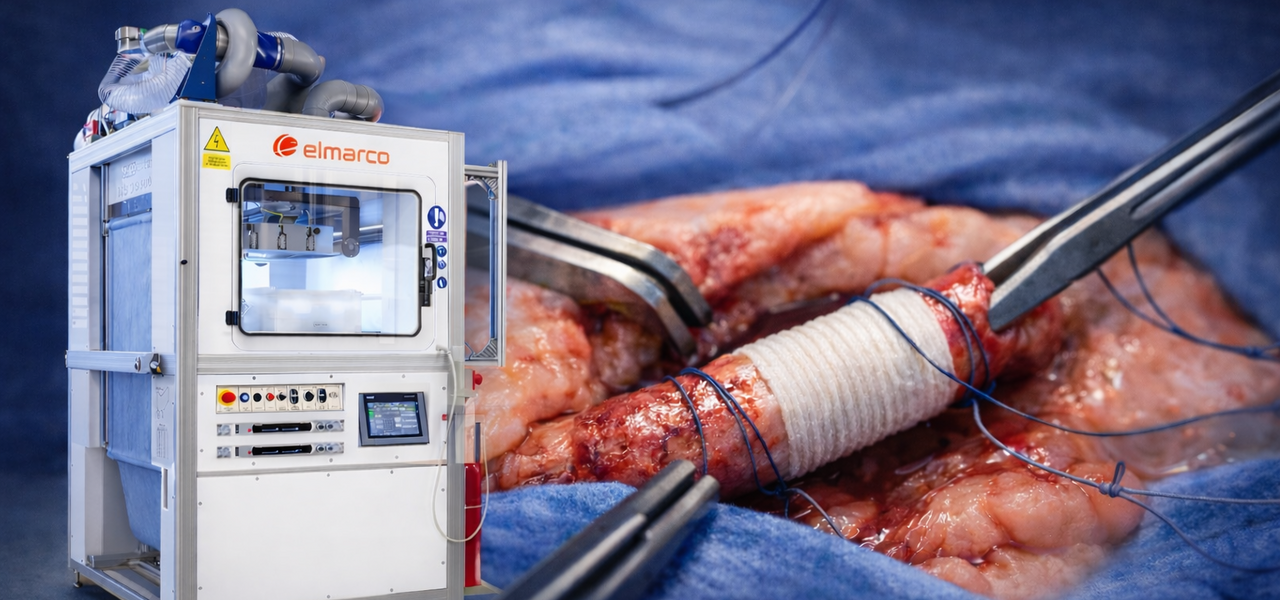
External vascular bandages are routinely used in cardiovascular surgery. They serve as arterial reinforcement, as vascular patches, or for procedures such as pulmonary artery banding (PAB) in infants. Traditionally, these bandages are made from Gore‑Tex (PTFE), a non‑degradable material often referred to as a “forever chemical”. Once implanted, it remains in the body permanently and does not resorb.
The goal of this research project was to identify a biomechanically suitable, biodegradable alternative. The new bandage had to meet several strict criteria:
-
• sufficient mechanical strength combined with high flexibility
-
• ability to be wrapped easily around a blood vessel during surgery
-
• controlled support of blood flow and vessel regeneration
-
• gradual integration into the vessel wall
-
• complete biodegradation without the need for surgical removal
In short, the material had to support healing and then step aside.
Nanofibers at the core of the solution
A crucial part of the project was carried out by the Department of Bioengineering at the Faculty of Science, Humanities and Education, Technical University of Liberec (TUL), under the leadership of Assoc. Prof. Eva Kuželová Košťáková. Her team prepared nanofibrous layers from biodegradable polyesters, tailored specifically for cardiovascular applications.
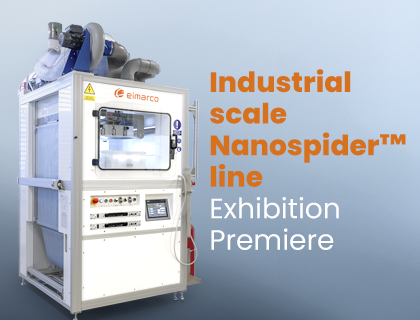
The nanofiber layers were produced using ELMARCO's Nanospider™ technology, enabling precise and reproducible fabrication of nanofibrous structures with defined thickness and surface properties.
“Nanospider™ technology allows precise and repeatable production in a relatively short time. Without it, achieving these results would most likely not have been possible,”
explains Assoc. Prof. Kuželová Košťáková.
Based on systematic testing, the researchers selected nanofibers made from a caprolactone-lactic acid copolymer with a higher surface density as the most suitable material.
From nanofibers to living tissue
The project brought together four major research institutions, each contributing essential expertise:
-
TUL produced the biodegradable nanofibrous layers by electrospinning
-
Institute of Rock Structure and Mechanics of the Czech Academy of Sciences impregnated the nanofibers with a collagen matrix
-
Faculty of Medicine, Charles University in Pilsen, together with cardiac surgeons from University Hospital Pilsen, performed surgical implantation and in‑vivo testing
-
Czech Technical University in Prague (CTU) conducted biomechanical testing of both original and explanted materials
In‑vivo experiments were carried out on rabbit and pig models, focusing on carotid arteries.
Researchers monitored:
• mechanical behaviour of bandaged vessels
-
• comparison with healthy control vessels
-
• tissue integration and regeneration
-
• degradation behaviour over time
The bandage was designed to provide mechanical support for approximately eight weeks, corresponding to the critical healing phase. Complete degradation was observed after roughly six months.
Importantly, the polymer degrades into natural metabolites: water and carbon dioxide, with degradation speed influenced by material morphology, surface area and collagen combination.
When biology surprises even experienced surgeons
Testing materials inside living organisms remains one of the biggest challenges in biomedical research. The team describes in vivo testing as working with a “black box” that yields unexpected outcomes.
One striking example involved a control Gore‑Tex sample implanted in a rat. When surgeons attempted to remove it weeks later, its shape had completely changed due to biological interaction, surprising even highly experienced clinicians.
Such findings further highlighted the advantages of biodegradable materials that interact with tissue and do not remain as permanent foreign bodies.
A proven pathway from lab to clinic
While clinical application in humans will require further trials and certification, the project successfully demonstrated that the developed nanofibrous bandage is:
-
mechanically functional, biologically safe, reproducibly manufacturable.
“We have shown a viable pathway. The next step would be clinical evaluation and certification,”
notes Assoc. Prof. Kuželová Košťáková.
Beyond its scientific impact, the project also represents a significant educational milestone, reinforcing for bioengineering students that their work can translate into real‑world medical innovation.
Nanospider™ technology enabling biomedical innovation
ELMARCO does not supply nanofibers. We deliver complete solutions and, above all, industrial‑scale technologies for their production.
This awarded research is another example of how Nanospider™ electrospinning technology enables scientists and engineers to:
-
• precisely design nanofibrous materials
-
• scale production with high reproducibility
-
• explore advanced biomedical applications
From filtration and membranes to regenerative medicine, nanofibers continue to shape the future of materials science. We are proud to support researchers who turn fundamental science into solutions with real clinical potential.
Sources
This article draws on publicly available information from VědaVýzkum.cz and the Technical University of Liberec (TUL) regarding award-winning research on biodegradable nanofibrous vascular bandages.
-
Bandáž zpevní cévu a rozplyne se. Vědecký úspěch ocenil ministr — VědaVýzkum.cz
https://vedavyzkum.cz/inovace-a-transfer/inovace-a-transfer/bandaz-zpevni-cevu-a-rozplyne-se-vedecky-uspech-ocenil-ministr -
Bandáž zpevní cévu a rozplyne se. Vědecký úspěch ocenil ministr zdravotnictví — Technical University of Liberec
https://tuni.tul.cz/a/bandaz-zpevni-cevu-a-rozplyne-se-vedecky-uspech-ocenil-ministr-166335.html